

20 March 2026.
Information for Queensland Producers
This information is valid as of the 20/03/2026. Members are encouraged to review their inbox for the most up to date information as part of our regular updates on our EPBC Advocacy.
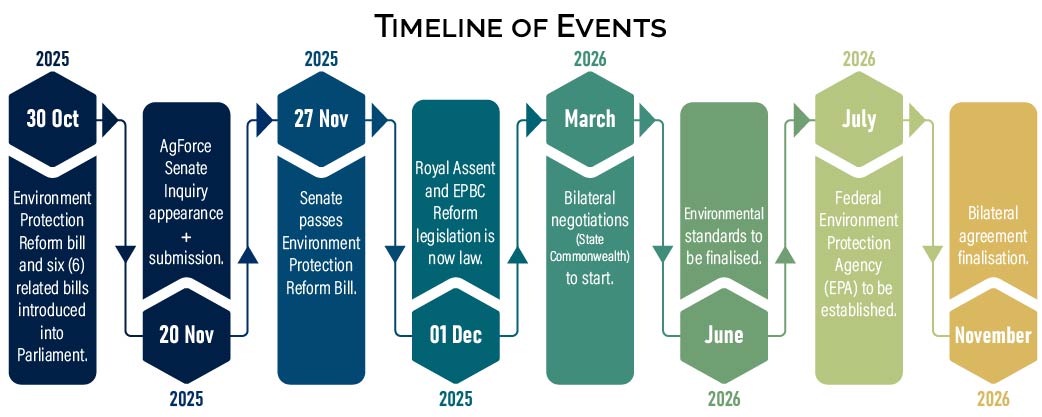
The Australian Government passed the Environment Protection Reform Bill 2025 and six related Bills 1 December 2025. As part of this, there are significant changes to the Environment Protection and Biodiversity Conservation (EPBC) Act, Australia's primary Federal environmental legislation.
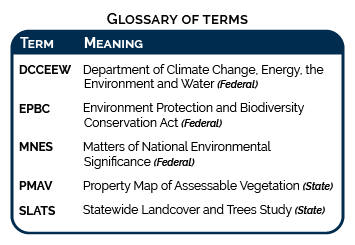
These reforms may change how certain agricultural activities are assessed where they may impact Matters of National Environmental Significance (MNES) such as threatened species (both flora and fauna), ecological communities, Ramsar Wetlands and the Great Barrier Reef.
AgForce is actively engaging both the Commonwealth and Queensland Governments to ensure the implementation of these reforms does not impose unintended or impractical outcomes on agricultural production systems. Rather, reflecting the practical realities of agricultural production and the existing environmental management frameworks already operating across Queensland.
This page provides a comprehensive overview for producers, outlines what the changes may mean, and explains how AgForce is advocating on behalf of members.
On this page:
What changes may affect producers under the EPBC Act Reforms?
1. Interaction between Commonwealth and State environmental legislation
While most environmental regulation in Australia is administered by State and territory governments, the EPBC Act provides the overarching Commonwealth framework for matters considered nationally significant. This means that in some circumstances an activity that is lawful under State legislation may still require consideration under the EPBC Act if it is likely to significantly impact a Matter of National Environmental Significance (MNES).
The reform process is intended to strengthen national environmental protections and alter how Commonwealth and State systems interact to minimise duplication. Ensuring that existing State regulatory frameworks such as Queensland vegetation management and planning systems, are recognised within Commonwealth decision-making is a key priority for AgForce.
2. Compliance, new environmental agencies and national data systems
The reforms establish several new national institutions intended to strengthen environmental oversight and data transparency. A new National Environment Protection Agency (NEPA) will be responsible for compliance, enforcement and auditing of environmental approvals under the EPBC Act. This agency will also oversee bilateral agreements with State governments and monitor how environmental standards are implemented.
In addition, a new statutory role, the Head of Environment Information Australia (EIA), will oversee the collection and publication of national environmental data, including regular State of the Environment reporting. These institutions are expected to increase the role of environmental data and monitoring in future environmental decision-making.
The reforms also significantly strengthen compliance powers under the EPBC Act. This includes increased financial penalties for breaches, expanded auditing powers, and the introduction of Environment Protection Orders that can be issued to stop activities where significant environmental harm is suspected. These changes introduce expanded compliance powers, including increased penalties and enforcement mechanisms, which will have direct implications for landholders.
It is therefore critical that these settings align with on-ground agricultural realities and existing state laws to avoid unnecessary regulatory burden. AgForce is advocating strongly on this basis. As these reforms progress, strong member backing will be critical to ensuring Queensland producers are effectively represented.
To become a member and find out more, click here.
3. Protecting Matters of National Environmental Significance (MNES)
The EPBC framework protects nationally important environmental values, including:
- Threatened species and ecological communities
- Ramsar wetlands
- World Heritage areas
- Migratory species
- Commonwealth marine areas
- The Great Barrier Reef Marine Park
Under the reform framework, activities that may have a significant impact on MNES may require assessment under the EPBC Act. The reforms also introduce new environmental decision tests that will guide how impacts are assessed. Current proposals indicate that projects maybe required to demonstrate that they avoid “unacceptable impacts” on MNES, and where impacts cannot be avoided, proponents maybe required to demonstrate a “net gain” environmental outcome, often through offsets or mitigation measures.
The detailed definitions of these tests are still being finalised through the development of National Environmental Standards, which will play a central role in how environmental decisions are made under the EPBC Act.
AgForce is actively engaging with government to ensure that these frameworks appropriately recognise the cyclical nature of agricultural production systems, critical food security and land stewardship role producers play in managing Australia landscapes.
4. Introduction of National Environmental Standards
The Commonwealth is introducing National Environmental Standards to guide how environmental decisions are made under the Act.
These standards will set expectations for:
- environmental offsets
- data and monitoring
- decision-making processes
- First Nations Engagement
These standards are still being drafted and are not yet complete. They are proposed to provide greater consistency across jurisdictions, but the interaction with existing State systems such as Queensland's vegetation management framework is still being clarified.
5. Potential changes to how environmental impacts may be assessed
The reforms are proposing new assessment approaches for producers including:
- self-assessment tools for certain agricultural activities
- updated referral pathways to the Commonwealth
- revised compliance and enforcement processes
- greater use of environmental data and mapping
At present, there remains uncertainty around when a producer may need to undertake a self-assessment or referral, and how these requirements interact with existing State approvals. AgForce is actively working with government to ensure these processes are clear, practical and proportionate for agriculture and will update members directly.
Potential implications for producers
For most producers, everyday land management activities that are already lawful under State legislation are expected to continue to operate as normal, however this remains subject to final implementation settings. Certain activities that significantly change land use or may have a significant impact on MNES protected could potentially trigger additional consideration under the EPBC Act.
Examples that may require closer consideration include:
- large-scale land clearing or vegetation modification
- new irrigation developments
- construction of major infrastructure
- activities that may affect threatened species habitat of MNES
- other activities that require additional State planning approvals
It is important to note that implementation guidance is still evolving, and AgForce is working to ensure producers have clear and practical information before new processes are fully operational and will update members directly as this progresses.
For further information, including AgForce submissions and direct policy positions, access the members login area here
To find out more about AgForce Membership, click here.
AgForce's advocacy on behalf of producers
AgForce has been actively representing producer interests in the EPBC reform process to ensure agriculture is strongly represented in how the reforms are implemented. Our work includes:
1. Direct engagement with government
AgForce is working directly with:
- the Federal Department of Climate Change, Energy, the Environment and Water (DCCEEW) and relevant Ministers
- the Queensland Government and relevant Ministers
- the National Farmers Federation (NFF) and associated members
This engagement is focused on ensuring the EPBC framework:
- recognises existing State regulatory systems
- provides planning certainty for producers
- avoids duplication of approvals
- remains practical for agricultural landscapes
- minimises or mitigates the financial and administrative burden on producers
2. Securing practical implementation settings
AgForce is advocating strongly for:
- clear thresholds for when EPBC processes apply
- exemptions for critical routine agricultural activities
- fit-for-purpose self-assessment tools tailored to agricultural activities
- recognition of Queenslands existing vegetation and land management frameworks
- streamlined Commonwealth State bilateral arrangements
These settings are critical to ensure environmental outcomes can be achieved without creating unnecessary regulatory burden for producers.
3. Ensuring fair, proportionate and practical compliance settings
AgForce is also actively engaged in discussions with government regarding compliance processes under the EPBC Act. Our priority is to ensure that:
- producers are provided with clear guidance before compliance expectations change
- historic matters are handled fairly and consistently
- regulatory approaches recognise the realities of agricultural land management
What producers should do now
AgForce will continue to update this page as further information becomes available. While implementation details continue to be clarified, producers can take several practical steps.
- Stay informed
- Seek advice for major land-use changes
If you are considering activities that may significantly change land use or involve large-scale development, it may be appropriate to seek advice before proceeding. EPBC implementation guidance is evolving and AgForce will continue providing updates to members as new information becomes available.
DCCEEW Contact details
The EPBC Act is federal regulation and we cannot provide members with direct interpretations. Where producers require property-specific clarification, the appropriate contact points remain:
- DCCEEW EPBC Hotline: 1800 803 772
- DCCEEW Referral Gateway (voicemail ): 1800 423 135
- DCCEEW Website: www.dcceew.gov.au/environment/epbc/approvals
Where possible, members are encouraged to request written confirmation of advice provided by the Department following any conversations.
We understand that response times are currently longer than usual, and this issue has been raised directly with government.
If members experience difficulty obtaining clear advice or receive contradictory guidance, please notify AgForce so these issues can be raised directly with the Department.
Member feedback is critical to ensuring government understands how these reforms affect producers on the ground. Thank you again to members who continue to share their experiences and supported AgForce's advocacy efforts.
Next steps in the reform process
The EPBC reform process is ongoing and several important elements are still being finalised, including:
- finalisation of National Environmental Standards
- development of self-assessment processes
- Commonwealth - State bilateral arrangements
- guidance on compliance and enforcement settings
AgForce will continue to work closely with government to ensure the final implementation of these reforms delivers both strong environmental outcomes and practical regulatory settings for Queensland agriculture.
AgForce Members can expect regular update on the EPBC settings, to find out more about AgForce Membership, click here
Members can access AgForce submissions, assets and other EPBC resources directly through the member portal, click here
Contact
If you have further questions or wish to provide feedback, please contact: AgForce Policy Team
- Anna Fiskbek - Policy Advisor - fiskbekA@agforceqld.org.au
- Josefine Pettersson - EPBC Lead - petterssonj@agforceqld.org.au